Visualizing Pectin Dynamics in Living Plant Cell Walls
November 18, 2025
In a comprehensive review titled "Engineering carbohydrate-based particles for biomedical applications: strategies to construct and modify" published in ACS Applied Bio Materials (2021), Thattaru Thodikayil, Sharma, and Saha provide an in-depth analysis of the design and utilization of carbohydrate-based micro/nanoparticles as innovative biomaterials for therapeutic applications. This work highlights the unique advantages of carbohydrate systems, such as inherent hydrophilicity, biocompatibility, and targeting capabilities, which enable precision drug delivery and enhanced in vivo stability. The review details advanced synthesis strategies, including the functionalization of inorganic nanoparticles like gold and iron oxide, as well as the development of polymeric and polysaccharide-based particles through methods such as click chemistry and self-assembly. It further explores key factors influencing performance, such as particle size, shape, and ligand density, and discusses biomedical applications spanning drug delivery, gene therapy, and theranostic approaches. By synthesizing cutting-edge research, this article establishes a foundation for future developments in carbohydrate-based biomaterials, addressing challenges in scalability and clinical translation while underscoring their potential to revolutionize targeted therapeutics.
The Unique Advantages of Carbohydrate-Based Systems
Carbohydrates offer remarkable advantages that make them ideal for biomedical applications. Their inherent hydrophilicity, well-defined structures, and ease of functionalization provide a solid foundation for developing advanced drug delivery systems. Most importantly, carbohydrates demonstrate selective targeting toward specific cell sites, enabling precision medicine approaches that minimize side effects and maximize therapeutic efficacy.
The review highlights how carbohydrate-coated nanoparticles significantly enhance "in vivo residence time" – the stability of particles in biological environments – while reducing potential toxicity. This characteristic is particularly valuable for drug delivery applications where prolonged circulation time directly correlates with improved therapeutic outcomes.
Innovative Synthesis Strategies
- Carbohydrate-Decorated Inorganic Nanoparticles
The authors detail sophisticated methods for creating carbohydrate-conjugated inorganic nanoparticles, including gold, silver, iron, and silicon-based systems. Gold nanoparticles, for instance, can be functionalized with thiol-derived oligomannosides through one-step or two-step methods, resulting in particles that show exceptional binding capabilities with specific lectins.
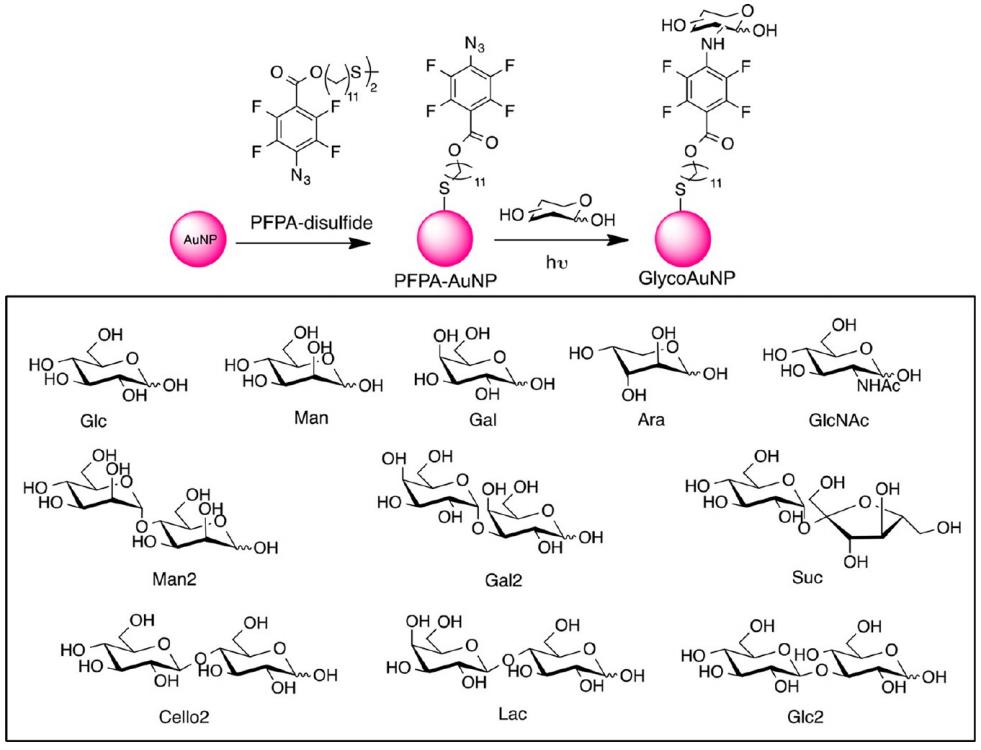 Fig.1 Synthesis of carbohydrate ligands and their conjugation to gold nanoparticles. (GlycoAuNPs).
Iron oxide nanoparticles benefit from carbohydrate coatings that prevent oxidation and aggregation while facilitating cellular insertion. The review describes various fabrication techniques, including hydrothermal methods, click reactions, and precipitation approaches, each offering unique advantages for specific applications.
Polymeric and Polysaccharide-Based Nanoparticles
Beyond inorganic systems, the authors explore carbohydrate-decorated polymeric nanoparticles and particles constructed entirely from carbohydrates. Amphiphilic glycopolymers can self-assemble into sophisticated nanostructures with hydrophobic cores and hydrophilic carbohydrate shells, ideal for drug encapsulation.
Polysaccharides like chitosan, dextran, and cellulose form the basis of another category of nanoparticles. These biomaterials leverage natural abundance and biocompatibility while offering versatile modification possibilities through covalent cross-linking, ionic cross-linking, polyelectrolyte complexation, and self-assembly techniques.
Factors Influencing Performance
The review provides crucial insights into how particle characteristics affect biological interactions. Studies demonstrate that smaller nanoparticles with longer ethylene oxide spacers show stronger binding affinity, while the shape of particles significantly impacts cellular adhesion, with nanorods exhibiting up to 80-fold better bacterial cell adhesion compared to spherical particles.
Ligand density and linker length also play critical roles in determining cellular uptake efficiency. Longer carbohydrate chains promote higher hydration layers, enhancing chain flexibility and consequently improving cellular interactions and uptake rates.
Biomedical Applications
- Advanced Drug Delivery Systems
Carbohydrate-based nanoparticles excel as drug carriers due to their ability to improve the water solubility of hydrophobic compounds, enhance bioavailability, and provide targeted delivery. The review highlights how carbohydrate wrapping extends in vivo circulation time and enables triggered release through environmental stimuli like pH changes or enzymatic activity.
Mono- and disaccharide-functionalized systems demonstrate remarkable specificity, with mannose-conjugated nanoparticles showing enhanced binding to dendritic cells and glucose-based systems providing pH-dependent release mechanisms. Polysaccharide-based carriers, particularly chitosan and dextran formulations, offer additional benefits like mucoadhesive properties and controlled release profiles.
- Cutting-Edge Gene Therapy
The review emphasizes how cationic polysaccharides like chitosan form effective complexes with genetic materials, overcoming challenges associated with viral vectors. Carbohydrate-based non-viral gene delivery systems show reduced toxicity while maintaining high transfection efficiency, opening new possibilities for genetic disorder treatments.
- Innovative Theranostic Approaches
Perhaps most impressively, carbohydrate nanoparticles enable theranostic applications – combining therapy and diagnostics in a single system. The authors describe how dextran-based nanoparticles with disulfide linkages can be cleaved by intracellular glutathione, providing controlled drug release while allowing tracking through near-infrared fluorescence imaging.
 Fig.2 Synthesis of carbohydrate ligands and their conjugation to gold nanoparticles (GlycoAuNPs). (Thodikayil, et al., 2021)
Glycol chitosan nanoparticles exemplify this approach, successfully encapsulating both chemotherapeutic doxorubicin and Bcl-2 siRNA for combined therapy while incorporating imaging agents for monitoring treatment efficacy.
Connection to GlycoCLICK™ Technology
The methodologies and applications described in this review align perfectly with the innovative services offered by CD BioGlyco, a leading biotechnology company specializing in glycobiology research. Their GlycoCLICK™ platform provides comprehensive solutions that mirror the advanced techniques discussed in the research.
CD BioGlyco's services encompass:
Our expertise in GlycoCLICK technology positions us as an ideal partner for researchers looking to implement the cutting-edge approaches described in this review. Our specialized team offers guidance in designing carbohydrate-based particles for targeted drug delivery, gene therapy, and theranostic applications.
Future Perspectives and Challenges
While carbohydrate-based particles show tremendous promise, the review acknowledges challenges in scalable synthesis and economic viability. The authors emphasize the need for collaborative efforts between material scientists, chemists, and biologists to develop cost-effective solutions suitable for clinical translation.
Future research directions include exploring particles with dual targeting ligands – for example, combining mannose for macrophage targeting with fructose for cancer cell targeting – potentially offering synergistic effects for complex diseases.
Conclusion
This comprehensive review establishes carbohydrate-based particles as transformative biomaterials with vast potential in biomedical applications. The sophisticated synthesis strategies and diverse applications discussed provide a roadmap for future developments in targeted therapeutics.
For researchers inspired to explore these innovative approaches, CD BioGlyco offers the expertise and technological platform necessary to accelerate project development. Our GlycoCLICK™-based services provide the tools needed to harness the full potential of carbohydrate-based systems, from initial design to implementation.
Reference
- Thodikayil, A.T.; et al. Engineering carbohydrate-based particles for biomedical applications: strategies to construct and modify. ACS Applied Bio Materials. 2021, 4(4): 2907-2940.